Showing posts with label #passion. Show all posts

Wednesday, June 17, 2015

Good to be BAD: Why We Love the Villain

Every story needs a troublemaker. Have you ever wondered why the most enduring stories have the worst villains? Ever put down a book because you just didn’t care about the story? Maybe the stakes weren’t high enough. Maybe the bad guy just wasn’t…bad enough.


Several years ago someone gave me this advice: to write a strong plot, start with the antagonist. It sounds backwards, right? But from a storytelling perspective, it makes perfect sense to start with the villain. Here’s why:

The villain is often a twisted version of the hero. Strong villains have a motive that opposes your main character’s goals. If your hero wants to eat ice cream, your villain is blowing up ice cream delivery trucks because of some deep-seated sundae phobia. Both hero and villain have similar interests, but on opposite sides of the issue. They are two sides of the same coin.


The best villains have a tragic backstory. When we learn about these defining events in the villain’s past, we begin to understand why they act that way. Maybe the poor guy hates ice cream sundaes because his psychopathic mother forced him to eat giant sundaes every day until he got sick, while he was locked in the basement staring at decomposing rats. We sympathize. It’s a complicated and yet compelling feeling, to care about the villains even as they do horrific things.


Villains reflect the evil we see in ourselves and others. Let’s face it, there’s a villain in every one of us. Fictional villains just take it to a whole new level of badness, often with cool stage makeup and special effects. Fictional villains offer a safe way to voluntarily process the deep, philosophical horrors that play out in our own communities. Like that dark and terrible day when Blue Bell recalled all the ice cream because of the dread villain Listeria. There is evil in the world, Aurora.


Villains provide creative freedom. As writers, we spend hours developing the character qualities of our protagonists. For those of us who write series fiction, we need to stay within the confines of our main characters because they are the anchors that hold the whole thing together. But introduce a new villain to the mix, or give your existing villain a new toy, and all bets are off. Ice cream trucks explode. Banana splits ooze with poison syrup. Anything can happen.


And finally, the main reason we love a good villain:

Villains are unapologetically selfish. Hell-bent on getting their own way, villains are determined, driven, and will stop at nothing. Killing? No biggie. Blowing things up? Sure. Allowing gallons and gallons of delicious Blue Bell ice cream to go to waste? Whatever it takes. We might not agree with their methods, but if we’re honest with ourselves, we admire a villain’s commitment. Go hard or go home.

Next time you sit down to write, turn the monster loose. Make your villain more evil and powerful, so your hero can get stronger. Up the stakes. Give us drama, make us cringe, incite tears. Back your hero into a corner, give the villain the upper hand, and then see what happens. Can your hero overcome the strongest of villains? 


Now that’s a good story.

Wednesday, June 10, 2015

Process Makes Perfect?


The writing process of a an author may seem simple to the outside world. You get an idea in your head and you just write! It's this magical experience that takes you to another world, and the words just vomit out of you.


This is closer to the truth:


We often times have zero control over our muse and when it wants to show up. It may come from a song, a life experience, divine intervention, drugs....


 Each story is different, some characters scream louder than others to be written. Sometimes you have multiple plot bunnies hatching in your brain and you have to start a couple stories at once. Sometimes it's like pulling teeth to get your characters to talk to you, or amongst themselves.


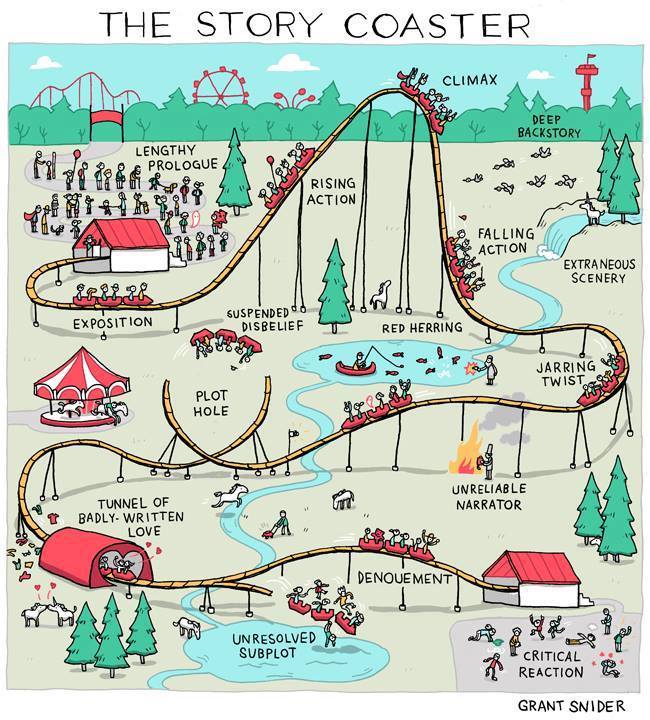
Sometimes writing is a giant roller coaster ride. (For the record, I hate roller coasters.)


Often times life gets in the way and absolutely no words get written for days, months, sometimes years.


This is pretty much me with every book I write:


Everyone has felt this at sometime in their career (more often than not, about every manuscript)


I wish with all my might that this was a real place. It would make it so much easier!!


Every writer is different with their process. Some write really fast first drafts but spend weeks and months, even years in the editing phase. Some plot every detail out with outlines and storyboards, sometimes even visiting the cities where they're setting their story so every detail is perfect and takes years in the making. Some spew forth words perfect on the first try and immediately land a six figure multi-book deal. (This is probably as mythical as Mr. Snuffeluffagus.)


But the point of this post (if there really is one besides just tossing around really awesome memes) is to say, do what works for you to get your story from your brain to the page. No one way is right. No way is wrong. If it works for you and makes beautiful words, do it. Sometimes it takes a while to find which way works. And that's okay, too. In the end, just never give up. If one way doesn't work, try a new one. Or invent your own. Spew forth all the words, my friends!


Monday, June 1, 2015

SAMBA OF THE STORY by Janice M. Wilson


(links below pics)
Rise!


If only life came with background music!   I think everyone would be a writer if that was true. 
Soft lullabies woo babies asleep.   A song played and sang with a foreign beat and language puts a mind back to an unforgettable trip overseas, or in the arms of loved ones.

Understandably, certain beats and lyrics playing at a particular scene is the perfect time to write out those feelings!

Music and natural sounds (yes, outdoors at a picnic table) gets me in a ready state of mind for writing better than any movie or television show could possibly approach. 

Music is a universal language we all feel 
and move to no matter who we are. 

Music affects almost all of the brain at the same time, connecting thoughts and feelings that would normally stay in different lobes which stirs up creativity from exciting different emotions or soothing over the world’s noises or our personal problems we are experiencing.

I can believe it.  Just put the jams on all day and it’s very likely I will write (start to finish) a lengthy piece by the end of the day.  Thank God for those great collections of all genres found on Youtube.com, iHeart, Spotify, Pandora, satellite radio (so many others) to be played for hours in just one click!

Focus on the place

Music often transports me to another place, most often in a balmy beachy place but I can be entranced to dream of a cool shady forest as well.  The right beat can ease my writing mind into leaving sandy foot prints on the pages much better and often for a longer duration than an inspiring picture. If I play something like Brazilian Bebel Gilberto’s Tanto Tiempo, at the very least I want to drag out my second novel which started with the Florida Keys as a backdrop.

Bebel Gilberto shares Samba da Benção

Speaking of place, playing the music of where your characters need to be in your novel is where it starts to get interesting.   Yes, gaze at that picture with the right music and – you’re there in spirit!  Your refreshed description will transport your reader there as well.

Who doesn’t speak Jamaican when we hear Bob Marley’s Jammin’?  There are not too many folks who are not immediately affected by some great reggae music!  Pass me the margarita pitcher, please!

Bob Marley's Jammin' (Live)


Focus on the senses

I heard The Boys of Summer in the car the other day and couldn’t wait to get home to write.  Why?  I felt 17 again!  I could smell the Giorgio perfume I was wearing those days, Miami Vice jackets on the guys (oh, that young Don Johnson set the heart on fire!)  Right there in the prime of life, I was young, slim, tanned and very hopeful for a gorgeous life ahead!   

The Boys of Summer (Don Henley)

What did I work on that day?   My young adult novel, remembering how everything was so new and the world so big an exciting, and I couldn’t wait to dip my toes in it.   I wanted my characters Jim and Bess to experience that too in the novel – and my young adult readers.


One song can transport a person’s mind all the sensual delights from a particular time and live it again in your mind. 
This is a great time to jot down some 
showing details for your work in progress. 

Find out what song does that for you and play it a few times.  Then tell me if you don’t itch to recapture those delicious details on paper!

Focus on the mood

So I come across a pivotal danger scene or a big lover’s quarrel that needs to jump off the pages.  No problem normally.  Except that day I was in a particularly happy and sexy mood.  THAT’S a big problem.

Do I stop current project at that scene or skip ahead and write out some lovey-dovey steam scenes? Sade helps me out with that, or Whitney Houston. 

Whitney sings I Will Always Love You
(I would certainly feel safe in his arms, too!)

Classic jazz will always put me in that mood, especially.  Love those happy songs that were played before the tv era, cheering everyone up during the wars!   I do enjoy writing out a good vibe for a little while because who would want to kill off a great mood?  But if I’m not sure where the scenes are going, I might pull out another work for that kind of mood and let the lovers have their way. 

In The Mood - Andrew Sisters

In nostalgic moments, I fiddle with nature writings as John Denver shares some of that Rocky Mountain High through the speakers.  Listening to Chopin or Beethoven skillfully strummed out of my speakers and I’m mentally driving down a windy country road in autumn.  The mood is set.

Chopin's Nocturne Op 9, No. 2

But back to the epic drama scene I can’t put off forever.  If I need instant anger, let me pull out some songs that remind me of some less than favorable love affairs and breakups. For some reason, the soundtrack from Braveheart or a few of those sexy James Bond theme songs can bring out the fightin’ Irish within.  Then – I’m ready! (ding!)


Focus on the inspiration

I have this novel sitting impatiently aside waiting for a good editor (and money to pay an editor – LOL) which was written towards young adult Christian folks, with hopes to inspire thinking first before making impulsive actions, among other things.  That required a lot of action and drama to keep the young readers interested (includes smoke jumpers and big deadly fires) to show consequences.  This time I needed some pretty hip fast action music. 

One Republic came to the rescue just in time with Counting Stars

Counting Stars (OneRepublic)

I couldn’t type fast enough and finished it in record time with the positive youthful vision and energy.   

Eddie Vedder’s solo-project Into the Wild soundtrack also gave some good insight. 
A Big Hard Sun (Into The Wild Soundtrack)

I will write for hours on their positive vibes.  (Getting better at singing it too!  Lol)

Focus on the moral

My personal blog (soothingprose.com) is usually about Christian moral lessons and integrating grace into real life using the memories from songs I had gleaned from prayer and prior life situations.

Also – when I get sick of the world and its violence and politics sometimes I seek shelter under some fabulous old hymns, both at church and home.  There are so many great messages in them and no contemporary Christian music moves me like the messages of faith and hope as the old songs can. 

Maybe your moral isn’t from a religious influence but you have one of love & revenge, justice, or grave injustices just the same.  A strong song can set that mood to write out the anger, the pain or the joy of seeing justice done.  You may be up all night writing on that tune.

Even flowing sounds that blend into each other and pique our dreamy minds (impressionists/ New Age).  It is a proven fact that playing clear and transparent (classical) music while writing or studying sharpens our memory and our logical thinking skills.   

Repetitive chords help us focus.

What else works for me is playing something patriotic - that sets my heart immediately in the right place! 
Alan Jackson's Star Spangled Banner


Focus on the impact

As far as the science of musical effects on our brains, a slower beat is considered anything under 60 BPMs, and exciting ones to invoke energy is over that.  

The best creativity invoking music is 
suggested between 50- 70 BPMs.

Songs are often written through the blood-sweat-tears experiences from musicians, and that’s not much different from us.  We put it on paper so the reader can sing and sail right through the imagines we create in their minds.  Musicians assail through their fans’ ears.  They also have to write all the words down and say so much more in such less space and time to convey their message.  This forces them to keep it a certain length for each genre of music, repetition, and the appropriate mood-invoking beat.

Eddie Vedder singing Guaranteed (live)
That point right there can be accomplished for writers by listening to that music the musician artists wrote and composed.  Focus on the point of the story and your impact by allowing the music to create a sensual and heartfelt (or exciting and dangerous) world for your reader.

Honestly, I don’t know many writers who don’t use music (before, during or after) to help their creativity soar.  Here are a few famous authors and what they listened to as they wrote their best sellers:

David Dobbs – a lot of Bach
Haruki Murakamih – Beach Boys/Springsteen

Gabriel García Márquez – The Beatles

Stephen King - Ryan Adams, Wilco, Alison Krauss, and Bob Dylan, LCD Soundsystem
J.K. Rowling – The Beatles, The Smiths

Doris Lessing: Phillip Glass

Who wouldn’t be inspired by this, one of the most popular romantic operas of all time:


I know, I know it’s just a beautiful man’s picture but he does sing!

Please feel free to share what music you listen to when writing, and what is inspired from it.

Tuesday, March 24, 2015

Find Your Passion, Write your Story


Today, I want to talk about how we as writers choose the stories we write, why we choose the way we do, and propose that we consider choosing our stories with passion in mind.

One of the things I love to ask fellow writers is how they began writing, and what they wrote at first. I am interested in how they got into the writing habit, and even why they chose the stories they did at first, but what I love most about those conversations is the joy that writers almost glow with, when they remember those first stories. 

These writers often have several things in common when talking about the stories. You can tell, just from the way they talk about them, that they loved these stories. Even though most are sitting in a drawer or stashed under a bed, they still love these stories. And do you know what? It comes through in the way they talk about them. 

One of the other things I've noticed, both in myself and in the writers I harass with questions about their writing, is that they often don't feel the same kind of passion for their later work. Today, I want to make some educated guesses as to why that is, and ask the question, well is that so bad?

There are quite a few reasons why I think the love for the story you see in first works can fade as a writer gains experience, but primarily I think it can be attributed to a single reason. 

We stop writing what we are passionate about.

There are a few reasons people stop writing about what flares their interest, about the things they love, or hate, or feel like matter most. 

Sometimes writers leave what they love to follow trends. They'll read that fantasy, or regency romance, or space operas are out. And so even though they have a wonderful story they love that falls into one of those genres, they put it off to write straight romance. There's nothing wrong with that, if you have a straight romance story you're passionate about telling. But if you don't, well forcing yourself to write something that you don't care about may not be the best idea. 


If you've been writing for very long, and have hung out with other folks in the writing game,another reason people leave off writing the stories they love probably became very apparent very quickly. 

There can be a class system in the the writing world. 

Well--several class systems actually, but the one I want to touch on today (in addition to other issues) is literary v. genre. The effects this class distinction has on writers--especially  genre authors can be very dampening. 

The message often comes across that genre authors are not real authors, and their books are looked down on as not real books. As incredible as that sounds, it tends to be prevalent in the industry. Far greater communicators than I have written essays and blogs and letters to the editor in defense of genre fiction, and they did a fine job. But the class distinction still exists, and it doesn't appear to be going anywhere. 

Not long age I attended a GENRE writing conference, (Romance) and heard a well known literary agent tell a romance publisher (in front of an entire room of romance authors) that she didn't publish REAL books. 

Because, apparently, romance books aren't REAL. 

I was floored, but sadly, that attitude is not unusual, and can make genre writers ashamed of writing what they're passionate about, or feel that they need to pursue more literary writing even though that isn't where their passion lies. 

This second reason feeds into the third reason. 

Fear.

When a writer is passionate about the story they are writing, be it lit fic or spaceships, or vampires or zombies, they are opening themselves up where it counts. 

Where they're vulnerable. 

And fear can be a very powerful reason for us to set aside the passion, the stories that matter, because if they fail, or get bad reviews, or God forbid--no reviews, well that failure would hurt so much worse than if we didn't open ourselves up. 

So why do it? Why open yourself up to that sort of vulnerabilty as a writer? Why is passion important in writing anyway? 

Because your passion comes through in your writing and readers can tell. 

If you don't love your story, neither will they. 

I know we've all read books where the writing wasn't amazing, but despite that, the author managed to pull in millions of readers and make them sigh and weep and care for their characters. And we've all asked the question how? 

How is it that this poorly written book has so many people fangirling over it?

Passion.

The author was passionate about the story, and it came through on the pages. It sucked us readers in because when we read we are searching for that passion for the characters and their stories. 

The converse is true for well written, well edited books that we want to love and read hoping all the way through that the attachment will happen (anytime now.) 

It never does and we end the book feeling underwhelmed and a little cheated. Without passion, that connection is less likely to happen.


Don't misunderstand me. 

Good writing is important. 
Good editing is important. 
Good formatting is important. 

But without passion, the story is flat. 
That's because writing, formatting, editing are just vehicles for the story. 

Passion is the point of the story.