Showing posts with label fantasy. Show all posts

Thursday, January 7, 2016

Writing A Series: An Inside Look

When I realized today was my day to write for the blog, I looked up in a daze from my latest WIP and thought...but what should I write about?  I asked the other Relentless Writers for suggestions and bemoaned the fact that I suck at blogging.

The conversation went something like this:

Me: I suck at blogging.

RW: You don't suck at blogging. Your posts are generally good. What you suck at is planning what to write. (*this is true)
 
Me: No, I really do suck at blogging. And planning.
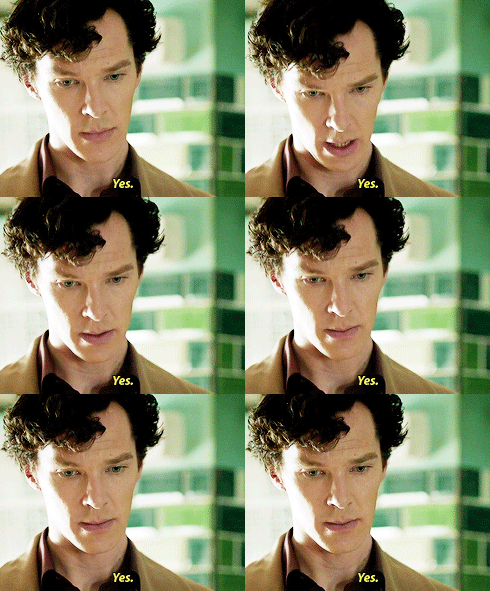
(even Sherlock agrees)

RW: Wait, I know. Have you done a post about writing a series yet? (*because I write a lot of series)

Me:  And what would I say about writing a series?

RW:  How did you maintain the continuity between the historical western books? Was it different from how you approached the sequel to Hunter's book? Is contemporary easier than historical? How do you keep track of things? Pinterest boards? Google docs? Have you ever had a reader (beta or otherwise) catch a continuity error? What'll you do to keep that from happening? Are there any sources for "how to write a series" that you've found particularly helpful? From an agent's perspective/your knowledge of the industry, what are the pros and cons of writing books in series? What's your best piece of advice for a newby starting out with a series?

Me:  Oh wow. Okay, so my answer to all that is...I didn't plan that far ahead (big shock, right?). I did it all as I went. Oh, and Google.

RW:  ...

Me:  My post can consist of this: How to Write a Series, by M. Madigan. Come up with a fabulous idea (or you hope it is. It sounds fabulous in your head at least). Make a page of general notes (It's contemporary/western/post-apocalyptic and there are maybe five core characters you'll focus on for the series). Make more specific notes for book one. Start writing. Worship Google. Start the next book by making specific notes. Shoe-horn it into the series to fit with book one. Lots more Google worshipping. Do the same for the rest of the books. The End.

 RW: Um. Don't forget gifs.


That's how the conversation went, but I'm being (mostly) facetious about the process (okay, only partly). Everyone who writes a series will have a different process, so mine is just mine and could probably stand to be improved upon.

However, how do you write a series is a legitimate question because in many genres (romance, mystery, scifi, fantasy), series are hot. Readers want them, agents and editors look for them, so writers need to think about writing them. 

I seem to be a series addict. I've got no fewer than eight in progress at the moment: the Nevada Bounty series (historical romance), the Caine Brothers series (erotic contemporary novellas), the Forever Faerie series (paranormal romance), the Tap Zone series (contemporary MMA romance), the Dragon Club (shifter romances), Never Too Late (second chance at romance/women's fiction), the Timed Out series (space opera), and the Tales from Beyond the End (post-apocalyptic fairy tale retellings).


(that's a lot of series)


Why do I write series? Because I like to set up a world, fill it with people, get to know them and then put them through the wringer. I think that's why readers like them, too. I know that's what I like when I'm reading them, so that's what I aim for as a writer.

But how do you write a series? I can give you some idea of how I do it, but again, all writers are different. I write romance and science fiction so I can get away with some loosey-gooseyness where authors of mystery and fantasy probably can't. Those genres require some pretty tight plotting and planning.

So although I was being snarky when I said this is what my post would look like, in the end, it kind of does:


How to Write a Series, by M. Madigan


1. I'm struck by a fabulous idea for a series.  Often when this happens, I'll brainstorm with another writer friend just to be sure the story idea sounds as good out loud as it does in my head. I also look at some of the stuff that's selling in the industry to see if the idea has merit. If it has potential to sell (for instance, if I came up with an idea for a vampire/angel/demon romance, even if it was amazing, I wouldn't write it because that stuff is dead right now. It'll come back around again eventually, but I don't want to spend time now on something I can't sell), I'll move on to step two.

2. Make a page of notes for the series. What's the genre? Who are the characters? When I came up with the idea for the Caine Brothers series, I immediately sat down and made some general notes for each brother - his name, what he does (billionaire, biker, SEAL, rock star, fighter, shifter), who his heroine is, and a short paragraph blurb for the plot. All these things are subject to change, but the notes give me a vague shape for the series.

3. Make more specific notes for book one. I'm not a detailed plotter, but I do want notes to work from. I don't like writing myself into corners (I did this with the space opera and it took me a long time and some rewriting to get out). I do a character profile for the main characters, a setting worksheet, and write a couple of pages of linear plot summary. Often I will expand these as I'm writing and need more detail. I also make note of important details like dates, quirks, props, secondary characters, relatives, etc...anything that can be used throughout the series to tie them together. I love Pinterest as a visual way to keep track of characters, setting, props, clothes, etc. I have Pinterest boards for each book and/or series. Google is also my friend. I never know what kind of research I'll need until I'm deep into the story, so sometimes there's a lot of stopping-digging-starting going on. Writing a historical western required some pretty interesting research (for instance, 19th century western curse words). One of the great things about being a writer (I think) is that I get to teach myself about a whole bunch of new stuff that I probably never would have learned had I not needed to research it for a book!

Once the first book is done (after I've had my awesome betas read it--and yes, they've caught stuff I didn't see like continuity things, improbabilities, practical problems) and off to an editor, or self-published, it's time to move on to the next one.

4. Start the next book by making specific notes. Repeat the process with the next book. I go back and look at my series notes, figure out who's next, what the general plot is about, then open a document to begin expanding that into a fleshed-out plot. I'll review my notes from book one to see what I need to carry over (themes, tropes, etc), and get to work on the next one following the same general writing process. I kid when I say I have to "shoe-horn it into the series to fit with book one" because although I don't have obsessively detailed series notes, I hope they're good enough I don't have to force anything. And if I come across a problem, I just see that as an opportunity for creative solutions.

5. Repeat the process for as many books as are in the series.


For me, that's it. That's the process. It's part organic, part planning, part linear, part disorder, often frustrating, but always a wonderful, juicy, creative, wild ride!

The point is, if you write series you need to find what process works best for you depending on what genre you write, but also what kind of writer you are. There's no right or wrong as long as you figure out some form of organization and creative process that works to maintain your continuity and inspiration.

(use yours)

Now, go write.

~Margaret


Sunday, January 25, 2015

Word-building in World-building (Sci-fi & Fantasy)

To Frell and to Frak


If Captain Adama says so, it must be right! So say we all!

     Even if you've only just dipped your toe into the cosmic pool that is sci-fi, you're sure to have stumbled upon some of these words - from the old school "smeg" to the everyday "frelling, frakking, goram dren." Whether in book or TV format, it seems like every alien language has developed their own non-taboo F-word to spice up their dialogue without angering the censors. The question is whether or not "Frak" is anything more than an excuse to shock the audience and load up on F-bombs. Do writers do this simply to avoid interference from the censorship that might come from use of their taboo, human F-bomb cousin, especially as fantasy and sci-fi typically attract both adults and children?

     My answer would be both yes AND no! Yes, they're totally used to shock. However, also NO! That's not their only purpose! We (or maybe just I) neeeeeeeed these words for authenticity of character and credibility of self-expression. 

     Take into account how the words are used and by who: "Frell" and "Dren" are used by a group of convicts constantly on the run; "Frak" is the fave word of the remnants of an army who are facing the decimation of their species on a daily basis; "Goram" pops out of the mouths of smugglers dodging the law on the outskirts of civilized space; and, last but not least, "Smeghead" is a popular insult bandied about between a group of mismatched bachelors floating around in space with little else to do other than ridicule each other. It'd be weird NOT to swear like an irreverent space-sailor in these situations. Personally, average school teacher that I am, I've been known to let out a "Frell" when just dropping all my class notes on the floor. Who knows what would come out of my mouth if faced with an apocalypse. Give the wayward, potty-mouthed felons a break.

     The intergalactic potty mouth is not really the issue here, more it is the example. In fantasy and sci-fi, we create whole worlds and those worlds need NEW WORDS! We need to express our characters' feelings and thoughts but in a whole new world that surrounds them and the reader too. Sci-fi and fantasy are all about pushing boundaries to new worlds and new cultures. Writers need new words and new languages to truly express these new places!

Not Everyone Gets to Have a Babel Fish


     Books have characters and characters have cultures and cultures have languages - there's no escaping it! And the odds are that, if you are writing sci-fi or fantasy, you will have a mix of cultures and languages to deal with. Unless you're Douglas Adams and you have a babel fish handy, you're going to have to deal with different languages and clashes of languages and cultures between your different tribes or courts or space boundaries. Some people advise just ignoring the potential differences and assuming everyone speaks the same language as the reader, but that's not the way I'd go. Some of my favourite sci-fi and fantasy tales have succeeded (in my opinion) because of the strength of their excellent world-building and the intrigue that a good-old cultural clash can create. Good language-building goes hand in hand with that.

     You don't have to be J. R. R. Tolkien to pull this off though. He's my ultimate hero of world-building and a philologist too. Don't get intimidated and back away from your keyboard! We can't all be him! Also, not all of us want to master Anglo-Saxon, create multiple alphabets and imagine up entire languages before we put pen to paper. We also probably can't afford to hire David Peterson (the creator of Dothraki and many other languages for TV) to work his language-creation magic for us. However, there are definitely some lessons to be learned from Tolkien and others.

(1) Find your own Balance between Old and New Words!


Life Buoy On The Boat Stock Photo
Think of your poor, drowning reader!!

      How much is too much when it comes to introducing new words on a page? As much as I worship Tolkien and admire his commitment to detail, I do remember racing through some Entish chapters to get back to where the more active narrative was at. Sometimes you can fall so in love with your own invention (be it back-story instead of language) that the reader gets the chance to become impatient with you. My own personal and inexperienced view on introducing a new language and new words to your reader is simple: DON'T DROWN THEM! I love languages and world-building but minimalist pages are the way forward. 

     Use your own language as your base and if there's a word for it in your language that will suffice, USE IT. However, if there's something new or unique to your created world, then give it a new word. I'd say that wine is simply wine because, you know, it's wine. However, if you're introducing a new kind of booze to your tale - one say that is distilled from a plant only grown on the planet colony AYW-82 and drunk by the slaves on that planet, then by all means name it "dengastil"! If there's a swear word that you want to use, replace it with "aiggak"! However, you don't need to replace the name of every object that your characters are going to encounter. Think of your poor reader.

     If you want to avoid losing the flow of your tale, don't get caught up in an explanation of everything every few sentences or so. At a writers' group, I was once asked why I hadn't included more "alien" words to describe the ubiquitous market scene. I accepted and nodded along to this perfectly valid critique of my work. Traditionally, market scenes are a great opportunity to show all the cultures of a world coming together to trade so it's the perfect chance to inform the reader about this world they are in. I listened and tweaked and added some more and it was better, but I didn't want to go too far with it. I hate info-dumps where the author decides to tell the reader everything dead quickly, rather than slowly showing bit by bit - and this is true of introducing new names for things too. On one page, I was happy to suggest to my reader what a "daga bloom" was as well as showing that the "angma balls" were sticky globs of sweetened tree sap that the kids craved. But I felt like two 'explanations' on a page were my limit. Also, notice that I made it easy for my reader by making my new words a mix of the exotic "daga" and the familiar "bloom" so that they at least had a general idea of what I was talking about. I kept on world-building with details without more word-building on that one page, as I didn't want to drown my reader in more new vocabulary all at once.

(2) To Build a World, you need to Build a Culture!


Frank Herbert's Dune meets the Simpsons (by Gulliver63) 

     Creating a new language isn't just about chucking some syllables together and making a new word. You've got to stay true to the culture you're creating. Don't bother creating any new words until you've already thought out the culture that uses them. One of my favourite examples is Frank Herbert's Dune in which the Fremen have their own language developed from Arabic. Water being the ultimate wealth on Arrakis, it impacts every part of life, from birth and the drinking of amniotic fluids to death and the reclaiming of the water from the body. One of many water-related sayings the Fremen use is, "Now do we consume that which will one day be returned for the flesh of a man is his own, but his water belongs to the tribe." Wasting water is sacrilege and, even when the Fremen language is translated for the ease of the reader, a ton of new words and phrases, like 'water debts' and 'water bonds,' are needed to explain the essentially alien culture and the reverence that they have for water. If you're just making up random words, you might be better off using your own language. Keep your word creations purposefully focused on the culture you're trying to share.

     Taking it to another level... if you've ever read Patrick Ness' Chaos Walking trilogy, you might have been impressed by how Ness dealt with inter-species communication. The protagonist, Todd, has a pet dog called Manchee and we are allowed into the conversations between boy and dog when Todd is infected with the noise-germ and begins to hear the thoughts of everyone around him, including his pooch. It may not involve the creation of an alien language, but it's a great example of language creation in order to share a totally different way of thinking through different ways of speech. Worth a read!!

(3) Be Consistent!

     To be honest, the only real RULE is to be consistent. There are a ton of different ways to do this:

- DON'T BE SCARED OF USING LANGUAGES YOU KNOW AND ADAPTING THEM! Some novelists loosely base their alien lingos on real languages from today or the past, thereby automatically getting some cohesion of style.

- FOCUS ON THE SOUND OF THE LANGUAGE AS IT REALLY HELPS WITH CHARACTERISING THE CULTURE. Some novelists decide on a sound that appeals to them, be it lilting or growling or guttural, and simply decide how many consonants to chuck in to rough things up. Make sure you try out your words aloud. If you can't pronounce them, your readers will probably struggle with them too. You're aiming for exotic, not unintelligible.

- KEEP A LIST! While writing, it's a good idea to create a dictionary or glossary as you go, so you can check language consistency on a few pages, rather than the whole manuscript.

- CHECK YOUR LIST! Once you've completed your list, give it to a friend to read out loud and see if they feel like the words are connected to the same language - without the distraction of the story.

- KEEP TRACK OF THE ALIEN WORDS BY HIGHLIGHTING THEM! I tend to highlight the 'foreign' words every time I write one, so they are easier to go back to and review.

- USE YOUR SPELL-CHECKER!!!! It is your friend! Add your new words to the spell checker so it doesn't either accidentally change your words OR drive you crazy prompting you whether or not you're sure...really, really sure...that that's a word! 
You can do this in MS Word by: Review > Languages > Language Preferences > Proofing Tab > Custom Dictionaries button > Edit Word List.


You've got to admire the commitment!! What a guy!
Borrowing from Anglo-Saxon and then creating a whole wealth of other languages!
http://www.acondia.com/fonts/runes/info/hobbit.htm