Showing posts with label writers. Show all posts

Monday, November 9, 2015

The Next BIG Thing

"A hero knows it takes hard work and a long time to get published; a fool thinks it should happen immediately, because he thinks he's a hero already.

A hero learns the craft; a fool doesn't think there's much to learn.

A hero keeps growing all his writing life; a fool thinks he's fully grown already.

A hero fights to make his writing worthy, even when no one's noticing; a fool demands to be noticed all the time, even if his writing stinks.

A hero is persistent and a professional; a fool is insistent and annoying.

A hero gets knocked down and quietly regroups to write again; a fool gets knocked down and whines about it ever after.

A hero makes his luck; a fool cries about how unlucky he is.

A hero recognizes the worth in others; a fool can't believe others are worth more than he.

A hero keeps writing, no matter what, knowing effort is its own reward; a fool eventually quits and complains that the world is unfair.

Be a hero." -James Scott Bell, The Art of War for Writers
Gilmore Girls


NaNoWriMo is upon us. For many that means plucking away with a group of like-minded individuals, in whatever space of time we can manage to free up to hit that 50,000 word goal. Many published novels have come from NaNo origins. The Night Circus by Erin Morgenstern for one. I don't know about you, but when I go into NaNo, I wonder just what I'll write. I'm not a plotter, so most of the writing I do during NaNo is pantsing. I enjoy envisioning a character and letting the words fly. Is it harder to clean up the words afterward? Sometimes. But at least the words are down.

Recently, I've heard a lot of discouraging chatter from one of my writers groups. Some wonder how the effort will ever be worth it if they don't come out the next big thing. THE NEXT BIG THING. They want to be the next JK Rowling, the next Stephenie Meyer, the next Stephen King. That's the only goal that they can see.

They won't be The Next Big Thing. I won't be The Next Big Thing.

Okay, never say never. They could. I could. It's always a possibility. The problem with their kind of thinking is that it's discouraging. Big Things happen because they were at the right place in the market at the right time in the market with the right agent and editor. Do you realize how many stars have to align for something like that to happen?
Lindsey Stirling, Stars Align


My son is nine years old, and the oldest. He was born 5 weeks early and was only 3lbs 3oz. I had to have an emergency c-section because I would have contractions and sleep through them, but his heart rate would drop from 160 to 90 every time. We were blessed. He didn't have any health problems other than needing a feeding tube for several weeks. He is small. He will be small until that one growth spurt hits and he shoots up to the stars. The other day I caught him and his 6-year-old sister trying to see who was taller with the help of their 5-year-old sister.

The inevitable happened. His sister has grown taller than he is. We knew this would happen. His pediatrician informed us the first time he saw our 3lb bundle of joy. Preemies struggle to catch up sometimes and one day he will shoot up. The Dr. has seen it happen a million times. Both of his sister's were born at 6 lbs 13 oz and 6lbs 8oz. They had a better chance of being bigger faster than he did. My son was upset. Why is his sister taller than he is? Why is she stronger than he is? I sat him down. I asked him what he thought the world would be like if everyone were the same height and strength? He said everyone would be like daddy. I asked him what he could do that his sister couldn't. He told me that he could build portals in Minecraft (yes, our world currently revolves around Minecraft).

So, I put things in Minecraft terms. I asked him,  "What if no one could build portals? What if they could only build houses?"

He thought on this for a few minutes. I don't know the importance of portals in Minecraft, I've never played, but this seemed to be a big deal to him. He replied, "That would be boring. No one would be able to create anything."


I told him to continue to be a creator. Height and strength would come later, but creativity could never be replaced. He's since taken to drawing and creating more things on Minecraft. Apparently kissing cats creates babies. Who knew.

There will never be another writer like you. Stop trying to be The Next Big Thing. Focus on your writing, your style. Read what you love, write what you love and do your best to learn and grow. Learn from those authors you adore. Cultivate a career. Suzanne Collins had published the Underland Chronicles before The Hunger Games came out. Not every book your write is going to be a Big Thing. But every book you write could be a career. Continue to write because every time you do, your skills improve.

Be a squire struggling to prove himself a knight.
Heath Ledger, A Knight's Tale
Run with velociraptors.
Jurassic World

Be a hobbit struggling to make their way to Mount Doom. Be you. No one will ever know the formula for a Big Thing. No one can predict what will take off and earn millions. It isn't possible. But you can focus your energy on writing the best novel you possibly can. And who knows. Maybe the stars will align.
Galadriel, The Lord of the Rings
    

Monday, September 14, 2015

Celebrate Avelynn with Me


Today marks the 6th day that my book baby, Avelynn, has been out in the world. Here’s a little blurb and shameless self-promotion.
Happy Birthday Avelynn!
One extraordinary Saxon noblewoman and one fearless Viking warrior find passion and danger in this dazzling and sensuous debut.
 
869. For eighteen years, Avelynn, the beautiful and secretly pagan daughter of the Ealdorman of Somerset, has lived in an environment of love, acceptance, and equality. Somerset has flourished under twenty years of peace. But with whispers of war threatening their security, Avelynn's father makes an uncompromising decision that changes her life forever.
Forced into a betrothal with Demas, a man who only covets her wealth and status, Avelynn's perception of independence is shattered. With marriage looming, she turns to her faith, searching for answers in an ancient ritual along the coast, only to find Alrik The Blood-Axe and sixty Viking berserkers have landed.
In a year of uncertainty that sees Avelynn discover hidden powers, stumble into a passionate love affair with Alrik, and lead men into battle, Avelynn must walk a fine line as her deceptions mount and Demas' tactics to possess her become more desperate and increasingly brutal.
Avelynn and Alrik are caught in the throes of fate as they struggle to find the way back to themselves and onwards to each other.
Me and my book baby!
Released by St. Martin’s Press on September 8th, 2015, it’s been a time of great joy, apprehension, and wild frenzied excitement. We all know writing a book is a tremendous accomplishment. Period. And we know we need to celebrate the baby steps along the way: finishing a great scene, finalizing edits, getting a full manuscript submission request, meeting amazing writer friends. Whether you choose to indie publish or traditionally publish, once you see your book baby up on the big internet screen, it feels pretty damn good. You did it! You followed through and finished something many people want to do, but never manage to complete. You deserve a party! So today on the blog, I want you to lift your drinks high (whether it be tea, water, coffee, pop, juice, beer, whiskey, or wine) and celebrate with me.
 
It’s an awesome time to be a writer!
In gratitude,
Marissa xo

Wednesday, July 15, 2015

ROCK the CON: Pro Tips for Writers Conferences

(by Charlotte Levine Gruber, with Anna Davis)

Next week is the annual DFW Writers Conference. As Dallas area writers, Anna Davis and I thought we'd tackle pros and cons at the "Con."

Wrong kind of con, but still a great film.

My first professional writer’s conference was the DFW Con last year. I'd just completed the first draft of my first manuscript and made one (yes, one) weak polishing attempt. I had a writer friend to help break the ice. While my friend really helped my comfort level, it's often good to go without knowing anyone, forcing you to make new friends.


I've been to three conferences since, and have made several good friends. But the workshops—listening to other writers talk about what worked and what didn't—can help exponentially.

Generally, there are two tracks at conferences: 1) Classes on craft, publishing, and critiquing; and 2) Networking. Professional conferences are most effective when the writer can "work" both tracks. But for many writers, this is a step—or leap—outside of their comfort zone.

Anna and I have divided up tips for those who master track (1) and those who master track (2).


No, these are not the two tracks we want to master...


PRO TIP #1: Research classes ahead of time and plan accordingly.
While many writers are introverts, you'd be hard-pressed to find any of my friends or acquaintances who would call me shy. But at a conference? I'm all about the classes, the workshops, and the critiques. I'm planning my schedule now for the con that takes place in ten days.

Time spent researching the instructors is beneficial. Specific things I look for: publishing credentials, book sales, and genres. This research will help you decide which classes to attend, and will also help you prepare for each class so that you can get the most out of it.


Don't miss a class! Keep track of the schedule during the con.


PRO TIP #2: Use Twitter for Networking.
Here’s the deal: most of us writers just flat-out don’t like networking. We live in our heads because we like it there. But when you sign up for a conference, you’re paying a lot of money and taking time out of your normal schedule, and you don’t want to miss a huge benefit: MEETING OTHER WRITERS.

So in the interest of all that is good and holy about networking, take advantage of Anna's little-known conference secret: Use Twitter.

If you don’t have a Twitter app on your mobile device, GET ONE. Twitter is the business card of the digital age. It beats Facebook hands-down for speed networking situations like conferences and conventions.


If you have Twitter but don’t know how to use it, LEARN. You don’t have to be a Twitter expert. You just need to know how to follow people and how to look up a hashtag (like #DFWCon, for example). 

Knowing how to make lists would help, too. If you create a list for the conference ahead of time, you can easily add new contacts to that list throughout the con. When you go home, completely brain-dead and exhausted, you will have a record of who you met. You will also have a way to get in contact with them again. And you might even have their picture. Twitter is a mysterious and powerful type of networking magic.


Dazzling. Shocking. Twitter can be your best con strategy.

Twitter is a useful tool for all writers, but especially for introverts and others who might struggle with a slew of socially-challenging conditions (anxiety, ADHD, a hatred for small talk, etc.).

Plus, there’s nothing more fun than live-tweeting during a class, seeing someone else’s tweet about the same class (because you both hashtagged the conference and class name), and looking over to see that person with phone in hand, hunkered down, sharing the same experience online but not especially comfortable in social situations. Like you.

Writers: Twitter can be your best #networking tool ever. #GetTwitterNow #IntrovertsUnite #ConTips 


Wednesday, April 1, 2015

Hiding In Plain Sight - Thoughts about author pen names


So the romance teakettle was in a bit of a tempest last week when Jane Litte from the Dear Author review blog announced she was also indie author Jen Frederick.

Jump HERE to read her statement, detailing her reasons for keeping the pseudonym separate from her Dear Author persona.

Jump HERE to read an anonymous post on The Passive Voice blog, detailing why her rationalizations might be kind of bogus.

This is a tremendously complicated issue. I can totally see why Jane Litte would want to keep her roles separate by using different names. I can also understand why the anonymous blogger (who kept their own identity private for fear of retaliation by Ms. Litte or her allies) felt betrayed when it turned out that the Jen Frederick they knew from a private author discussion board was actually a prominent reviewer.

I can respect Ms. Litte for the stand she took in support of Ellora's Cave authors. She hasn't backed down, even though she's now the subject of a lawsuit brought by the publisher. On the other hand, I've seen her and her reviewers get into some pretty petty bitchfests with other authors, which makes me question their credibility.

Like I said, it's complicated.

Whether she's a hero or a villain or somewhere in between, Jane Litte is a smart and successful businesswoman, and her Jen Frederick pen name is going to be a lot more prominent when that movie deal goes through.

So why use a pen name?


Ms. Litte says she "partitioned off the fiction writing from the blogging, to keep (her) writing identity private" because "it was important that DA (Dear Author) remain its own, inviolate entity." She did it to keep her writing life separate from her day job, and of all the reasons to choose a pen name, I think this is the strongest.

Liv Rancourt is my pen name, and I chose to use it because I didn't want people doing google searches for Amy Caldwell, Neonatal Nurse Practitioner, to find pages of hits for vampire porn (as my children affectionately call my first book). When I started out as a writer, I had kids in Catholic school and sang in the church choir. I wanted the freedom to write on any topic without worrying what people who knew me in those contexts would think. I don't care so much any more, but back then I needed the barrier.

Now, if you're thinking about writing under a pen name so you can get back at the guy who broke your heart in high school or the Ice Queen who beat you out for a promotion, you should probably take a hard look at your motivation. As it says at the bottom of this post from WritingWorld.com, using a pseudonym won't protect you from legal action if the axes you choose to grind fall into libelous territory.

Building your brand.


Another reason for choosing a pen name is to compartmentalize, to give each genre you write in a separate identity. An easy example is romance writer Nora Roberts and thriller/suspense writer JD Robb. Same person, different genres, different personas.

Choosing separate pen names allows you to develop a clear brand for each one, which can help attract readers. The biggest downside involved is the amount of work involved in developing and maintaining two separate author brands - separate twitter profiles and Facebook pages and blogs and oh boy I might have a seizure just thinking about it.

It's possible to craft your brand on a level above genre - basing it on humor, or tough-talking characters, or a specific setting or socioeconomic level. Janet Evanovich, for example, writes funny, quick-thinking heroines, whether she's doing Stephanie Plum mysteries or Lizzy & Deisel paranormal stories or Kate O'Hare spy thrillers. Because she's so consistent, readers know what to expect from Ms. Janet, regardless of the genre of the story. (Jump HERE for a thoughtful post by Belinda Pollard on whether you need separate pen names for different genres.)

Building your brand - the reprise.

  • Say your surname is made up entirely of consonants. You might want to consider a pen name.
  • Say your name is undeniably feminine - Maybelle Valentine, for example - and you write political thrillers. You might want to consider a pen name. 
  • Say your parents, Tom and Mary King, named you Stephen. You also might want to consider a pen name.

I could go on, but I think you get the idea. There are circumstances where the name on your birth certificate should stay there, while you put something different on your published work. The tricky bit is figuring out what name to use.

The name should resonate with you and should be accessible for your readers. It's got to be something you can live with, because for the foreseeable future you're  going to be seeing and hearing it nearly every day. It should fit within the expectations for the genre you want to write. Ms. Valentine from the example above might be a hard sell as a thriller writer, but she'd fit in fine writing cozy romances.

There are all kinds of places to get ideas for pen names. Liv Rancourt is a close variation of my great aunt's name, Livia Rancourt. You might find a family name that would work, or a list of names in a source like the phone book might give you ideas. Wait, except we don't really have phone books any more. Use google then. You can do anything with google.

More seriously, here's another great post by Belinda Pollard with ideas for how to choose a pen name.

Learning and perfecting the craft of writing is important. So is learning the business side of publishing. Choosing a great title for your story is key. But how many times have you asked a friend,

"Hey, have you read the new one by (fill in the blank with the author of your choice)?"

The name you choose to publish under is the thing most readers remember. It'll be tied to their memories of your work, and it's a symbol of trust that you will both entertain and connect with them on an emotional level. In writing, as in every other part of life, you should think real carefully before doing something that betrays somebody's trust.

Peace,
Liv

What about you? Do you have a pen name? Why? Do you have any thoughts on the Jane Little/Jen Frederick brouhaha?

Wednesday, March 18, 2015

Living on the Edge: Writers as Outsiders

Are writers supposed to live on the fringes of society? I mean, as writers and artists, we regularly ponder horrific existential truths that would scare the pants off regular people. We’ve tapped into something huge, man. Something beyond everyday reality, an existence in the margins. Just makes sense we'd be outsiders, right?


Reality Bites (1994)

I’ve been percolating on this sentiment for weeks, but couldn’t really put words to it until I read poet Tony Hoagland’s recent column in The Writer. “I was living a vagabond life, encountering a lot of people who were living outside of all the systems,” writes Tony of his younger days. “That’s very important for writers, because we really are the outsiders, and we have to maintain our outside perspective…We really can’t speak truthfully or with that renegade precision that turns over rocks unless we know how to navigate between the systems and not to be co-opted by any of their resident vocabularies.”

Poet Tony Hoagland

I read Tony’s column while on a roadtrip with family and friends to New Mexico for Spring Break. It could’ve been my altitude sickness or the peculiar Native American landmarks, but his words resonated with me. A vagabond life…Renegade precision that turns over rocks…I don’t know about you, but something about that description gets me all fired up.


Almost every writer I’ve met views the world differently from the mainstream. For some of us it takes years to claim the role—pretending we fit in, trying to be normal, yet seeing things that others don’t (then shutting up about it, so as not to disturb the status quo). But somewhere along the line we'll sit down over a keyboard with reverence, take a deep breath, and start writing. When that happens, watch out. We’ll turn over rocks with renegade precision like warriors—word warriors—armed with smoking-hot vocab and deadly syntax.


Which leads me to my next point: is there something more substantial than gratuitous self-identification to this concept of writers as outsiders? Is there a purpose?

Yes and yes.

As writers, we put words to emotions and sensations that others feel but can’t articulate, so that when someone reads it, they think, “Yes—that’s exactly it. That’s how I feel.” This can happen in millions of ways in every genre. Stephen King once said that fiction is the truth inside the lie. When writers wrap a story around real emotions, readers identify with that story because they’ve also felt those same core emotions. It can be cathartic for both writer and reader.

Besides serving as emotional conduits, writers are also in the unique position of pointing out societal failings. Most people learn quickly in life not to speak of those little things (and sometimes really big things) in our culture that don’t ring true. Writers and artists have the ability to expose these discrepancies. Why? Because we’re outsiders. We know the lay of the land, but we see it from a different perspective.


So raise your coffee mugs and take up your keyboards, because right now someone out there might need you to flip over a rock or two. You’re a writer, baby. Get to work.


Thursday, March 5, 2015

Just step AWAY from the manuscript. **EDITING OBJECTIVELY**

It's not you, Manuscript, it's me. I think we need some space.


You may be asking yourself this same question. But it's true. 

This post is going to let you in on a little golden nugget of wise advice: 
Put a chunk of time and space between you and your manuscript before you edit.

Repeat after me: I will not edit for a minimum of 4-6 weeks. 

Now say it again!


Okay, realistically, this isn't always going to happen. If you're an established author on deadline with your publisher, you may work down to the wire. But even so, if you're an established author, you pretty much know this rule of thumb anyway, and hopefully those are the revisions that are down to the wire, and not the first draft to your editor. Give yourself enough time to let the manuscript sit, settle, and cool off before you attempt any edits.


I know you're looking at me with this face:


TRUST ME ON THIS! You will only do yourself a disservice if you attempt to edit or revise without clearing your head.

The best editing I've done is when I have put at least six months between me and a manuscript. Hell, I've even come back to ones after a year. It's amazing the things you will see with fresh eyes.

When you come at a manuscript while you're still in the heat of the moment, you won't catch things. While the story is still fresh in your mind, you're too attached to your characters to do any kind of edits objectively. In this day and age of instant gratification and technology, it actually hurts us more than helps us aspiring authors. It makes us send things out into the world well before they're ready.

EVERY author will tell you they've queried at least once, often times more than once, way before they should have. I know you want to put your book baby out into the world to be loved by an agent or editor and all your adoring fans just waiting to love on it. But don't put something out there you will regret in a year or two. Save yourself the regrets, and double shots of whiskey, while you're drowning in the query trenches up your eyeballs in rejection letters.


Your story plays out in your mind as you're reading it, so as the author, you have a tendency to gloss over things as you're reading. I guarantee you will miss grammatical errors that everyone else, and their cousins, will catch.


You need to be able to distance yourself from your characters, from your plot, from the way the story plays like a movie in your mind. Readers can't see the movie in your head, you MUST be able to put that to the page. If you don't come at it from a fresh angle, you will never be able to see what others see. And you have to in order to make others see what's in your head.

I guarantee it, plot lines happen in your mind without you even knowing it. A large portion of that never makes it into your story. Coming at your manuscript from a distance will allow you to be pulled into your world without being tethered. Your umbilical cord, for lack of a better term, will be cut and you'll be able to read word for word and see what's missing.


It will also allow you to read through it again as a reader, not as an author. If you find yourself skimming, then you know what you have to do.


When you can pick up your manuscript and say to yourself--"Wow, I don't even remember writing that. That was a great line!" Or, similarly, "Wow, what the hell was I smoking when I wrote this?" You're ready to edit.

On more than one occasion I've caught things in a manuscript after coming at it with fresh eyes and repeatedly facepalm myself. If you don't have any WTF moments when you're editing, you haven't put enough time and space between you and your darlings.


If you read through it and think what you've written is absolute gold, go put yourself in a timeout. Start writing something new, or take a writing break completely and watch some reality TV. That will give you some perspective. But that's another post for another time.

If you've read through the manuscript after letting it sit and you find yourself with a goose egg on your forehead from repeatedly facepalming yourself, get that red pen out and start slicing and dicing.


Also, grab your favorite editing drink of choice, you'll be in this stage for a while.


The thought of having to do revisions can be overwhelming. But every manuscript needs an edit. Every author will tell you that. Even the greats don't make a perfect first draft. A beautiful book baby is a lot of work. The majority of that comes from repeated revisions and letting go of your darlings; from characters to what you once thought were genius lines. 


In the end, you will have a gorgeous book you can be proud of. Nothing worth anything ever comes easy. So why put something out into the world that isn't your very best?


Some books take years of writing and rewriting. Some books come out a little quicker, but still need loving care and genuine, objective revisions. It'll be frustrating, it'll be agonizing, it'll be fun to kill off character, it'll give you pride to know you put your heart and soul into a project to make it its very best.

And then the day will come:


But that's another post for another time.

And for those of you ready to partake in the editing phase, after going through your waiting period of course, here's a link to a great month-long editing course: Janice Hardy's FICTION UNIVERSITY

Happy Editing!


Thursday, February 5, 2015

Do You Know Where You Are?

I was late to my first day of class. My prospects of making a good impression with the teacher decreased dramatically every time I ran up to a building only to discover that the class was no longer where it should be. The community college is a campus of buildings spread across small hills. The hills aren’t big or particularly challenging, except when you are late for a class you are hoping to add. Then it seems everywhere you go, you are either going up a hill or down one.

For the second time that morning, I climbed the steps to the student services building to get some help. This wasn’t the first time I’ve been to the campus or taken a class here, but a few years have passed, and I hardly recognized the school. Large areas, once rolling swaths of grass, were now cut up and fenced off with eight foot high cyclone fences, which gave you a sense of walking through a zoo rather than a school. Everywhere I turned seemed to be in some state of construction. A brand new fine arts building unexpectedly appeared before me. I then passed another new building, almost complete. A construction worker called down to his co-worker who yelled back over the din of jackhammers below. Students were scattered, milling around the bookstore, either reading their textbooks or talking to classmates sitting on the weathered wood benches, or gathered around the short adobe-like walls that
carved out small patches of green turf and surrounded the large oak and walnut trees.

I was told the creative writing class was in another building located in another area of the campus. This time, further east, near the parking lot, in one of the older buildings. I climbed yet another hill. Rather this time, it was concrete ramp, leading to a row of classrooms. The 70’s single story, flat-roofed building was unremarkable, except for its stark contrast to the newest building across the campus, jutting forth above the trees, like a trumpet pointing upward, as if to herald its arrival. Around the corner I heard the dripping of water and wondered, when did it rain? It didn’t. I obeyed the cautionary signs and watched my step.

By the time I reached the classroom, the right one this time, class was nearly over. My abrupt entrance interrupted the teacher, who had been in the middle of reading a poem out loud. He pushed his glasses up his nose to look at me. I recognized him immediately. I'd taken his class a number of years ago. Other than a few more wrinkles and a little more gray, he was the same as I remembered. Out of nervousness, I blurted out that I wanted to add his class.

The teacher asked, “Do you know where you are?”

I answered with a yes, but his question took me off guard. I reflexively looked around. Did I know where I was? The room was small and somewhat cramped. The L-shaped student desks were jammed so close together, there hardly seemed any space between them. A dampness clung to the air. The black built-in bookshelves on the back wall were empty, which seemed sad to me, especially for a creative writing class, but there was also a part of me that appreciated the irony of it. Writing students sat elbow to elbow, staring at me. I felt the heat rising underneath my shirt, and now wished I hadn’t grabbed the down jacket in my haste earlier that morning. 

“Do you like to read poems and short stories?” The teacher asked.

“I do.” Of course I do, I thought. I had the student loans to prove it.

“Do you like to write poems and short stories?"

“I do,” I said, except my voice wavered slightly. When was the last time I actually wrote a poem?

“First take a seat and see if by the end of the class you really want to be here.”

I took one of the seats that was off to the side, like a chair in time-out. I ended up sitting next to someone else who wanted to add the class. The teacher resumed his lesson, and I shifted into a “writerly” state of mind. I eased back against the hard, wooden chair, and listened to my classmates deconstruct a Billy Collins poem.

To be quite honest, I was back in community college, taking a writing class in order to force myself to write. It turns out I’d written more in one semester of grad school than I have in the five years after getting my MFA. My focus had since turned to publishing and my creative outlets were replaced more and more with design, mainly book design.

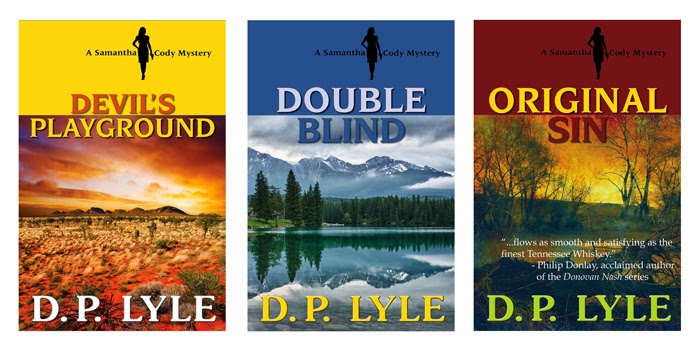
At the end of the class, the teacher gave me my first assignment, which was to write an edible poem or a poem with a sense of place. I chose the latter because I wrote an edible poem the last time I took the class several years ago (which you can read on Fictionaut). In trying to come up with a place to write about, I realized that one of the first things I want to know before designing a book cover is where the story is taking place. I often go into bookstores or stores with book departments to check out the latest book covers. Many books I found, especially genre fiction, evoke a sense of place on their covers.

 D.P. Lyle-Samantha Cody Mystery Book Series

A sense of place can pull you into the story and place you inside a character's point of view:
My house was at the very tip of the egg, only fifty yards from the Sound, and squeezed between two huge places that rented for twelve or fifteen thousand a season. The one on my right was a colossal affair by any standard-it was a factual imitation of some HĂ´tel de Ville in Normandy, with a tower on one side, spanking new under a thin beard of raw ivy, and a marble swimming pool, more than forty acres of lawn and garden. It was Gatsby’s mansion.
 -F. Scott Fitzgerald, from The Great Gatsby


Fitzgerald grounds the scene and situates the narrator with specific, concrete imagery. I’ve never been to a HĂ´tel de Ville in Normady, but I almost feel I’d recognize Gatsby's sprawling grounds and ostentatious mansion if I did.

Setting or a sense of place doesn’t have to be static either: 
If on leaving town you take the church road you soon will pass a glaring hill of bonywhite slabs and brown burned flowers; this is the Baptist cemetery. Our people, Talbos, Fenwicks, are buried there; my mother lies next to my father, and the graves of kinfolk, twenty or more, are around them like the prone roots of a stony tree. Below the hill grows a field of high Indian grass that changes color with the seasons; go see it in the fall, late September, when it has gone red as sunset, when scarlet shadows like firelight breeze over it and the autumn winds strum on its dry leaves sighing human music, a harp of voices.


I love the forward movement, like a camera lens moving, recording the landscape it encounters. It feels multi-dimensional and teeming with color. Capote adds texture with an element of sound. He also includes character background, history and uses direct address to pull the reader in further.

For the class assignment, I ended up writing a poem about Kauai, but as I wrote it, I wondered if readers would think it was Florida, so I narrowed the focus, bringing it down to road-level and kept moving as if the reader and I were making our way through the tropical trail, then pulling the narrative lens up for a grander sense of the place, a bird’s eye view. I even titled the poem “Bird Island.”

When I handed in the poem, I felt a sort of anxious acceptance. It has been a while since I’ve written something to share with someone else other than my cats. And it was in that moment, in that classroom with other writers reading, writing, and sharing, when I fully understood the teacher’s earlier questions. Yes, I know where I am now. I am exactly where I should be.